Competency-based nursing, from real patient encounters.
Every recorded student-patient encounter produces observed, scored, timestamped evidence aligned to the AACN Essentials.


Your self-study needs Domain 2 evidence. Here is what most programs have instead.
Simulation is practice, not proof
AACN's own guidance treats simulation as a formative learning strategy, not the summative record. A sim lab can teach the skill. It doesn't produce evidence that a specific student demonstrated it with a patient.
Faculty observation doesn't scale, and doesn't agree with itself
Watching one interaction at a time and scribbling notes is the modality AACN actually wants, and it's the one most programs can't staff. Three faculty watching the same interaction give three different scores, not from carelessness, just because human attention isn't uniform.
Clinical site capacity is the real ceiling
Placement sites are starting to ask programs to certify readiness before they'll take students, and for most programs, site availability limits enrollment more than classroom seats do. No readiness data means no proof, and a site that stops taking your students is lost revenue, not just a scheduling problem.
There was no way to document how students actually communicate with patients. Now there's a record.
Record. Analyze. Improve.
Three steps from a real patient conversation to an NCSBN-aligned assessment report, no faculty hours required.
Record the interaction
Students record authentic patient conversations on any phone or desktop, in the sim lab, clinical prep course, or active placement.
iOS · Android · WebAI separates the speakers
Automatic transcription with speaker diarization distinguishes student from patient dialogue for precise, fair analysis.
Diarization built inThe Domain 2 record writes itself
Scores mapped to AACN Essentials Domain 2 and NCSBN CJMM, plus specific coaching with alternative responses, in under 60 seconds, not weeks.
PDF export ready
What happens in the video
- 0:00 – 0:05 · The problem. Every nursing program teaches therapeutic communication. Almost none can prove a student learned it.
- 0:05 – 0:12 · Record. A student records a real patient conversation on a phone. NurseKind AI transcribes it and tells each speaker apart.
- 0:12 – 0:24 · Score. The encounter is scored against AACN Essentials Domain 2, with the NCSBN Clinical Judgment Model behind it. Faculty get the report in under 60 seconds. Nobody sits in the room.
- 0:24 – 0:31 · Evidence. Every encounter rolls up into a cohort summary and a per-student appendix. Export as CSV or PDF for a CCNE self-study.
- 0:31 – 0:37 · Review. Faculty review every score, and the rubric is theirs. Each review is logged, so the record holds up.
- 0:37 – 0:44 · Practice. Students practice on their own phone, any time.
- 0:44 – 0:47 · Close. Simulation for practice. Real encounters for the record.
One system for the skills that are hardest to measure
Real-encounter assessment
Authentic student-patient conversations recorded live in sim labs and clinical placements, transcribed with speaker diarization and scored against AACN Essentials Domain 2. This is where the accreditation evidence comes from.
AI patient simulation
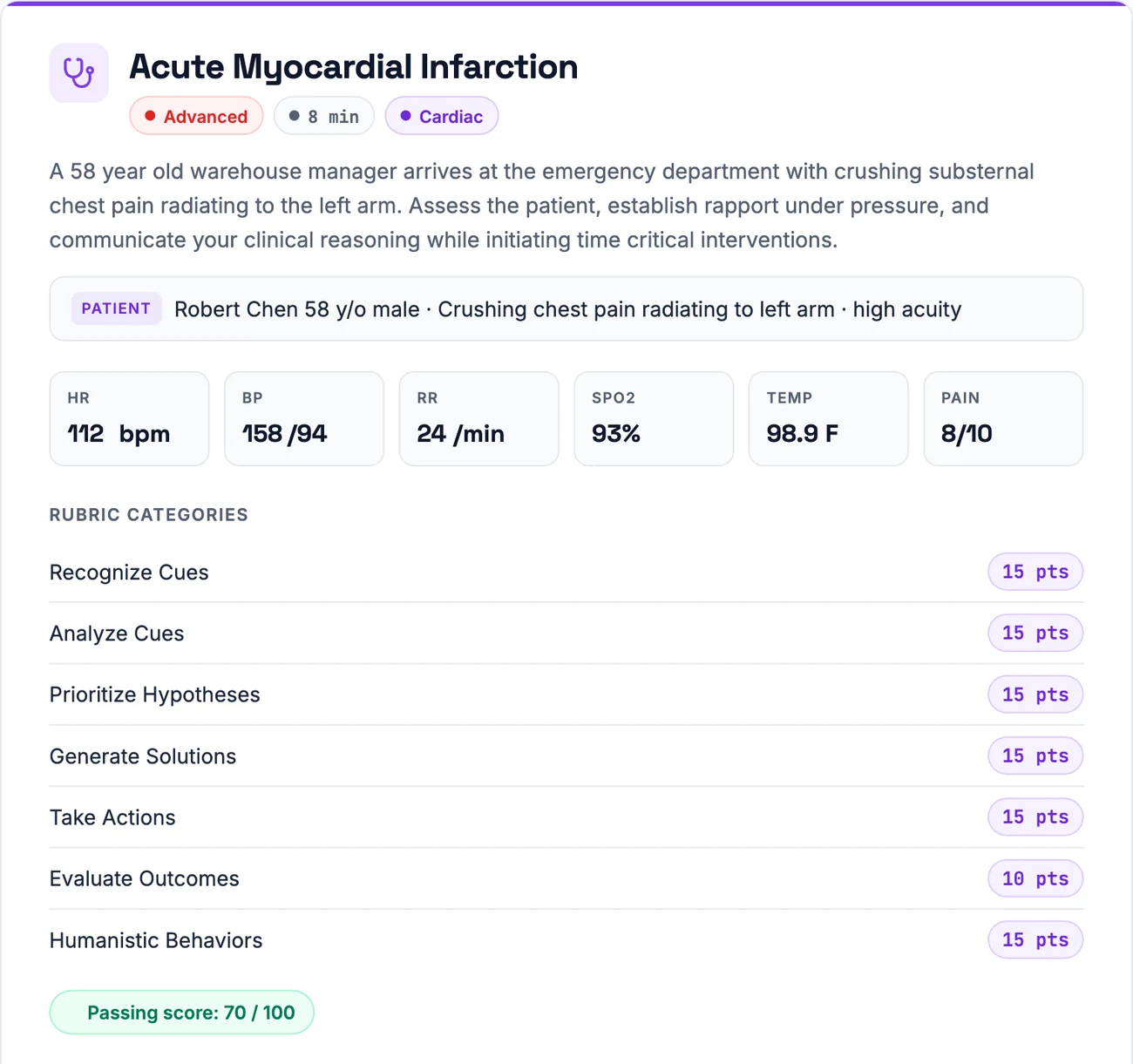
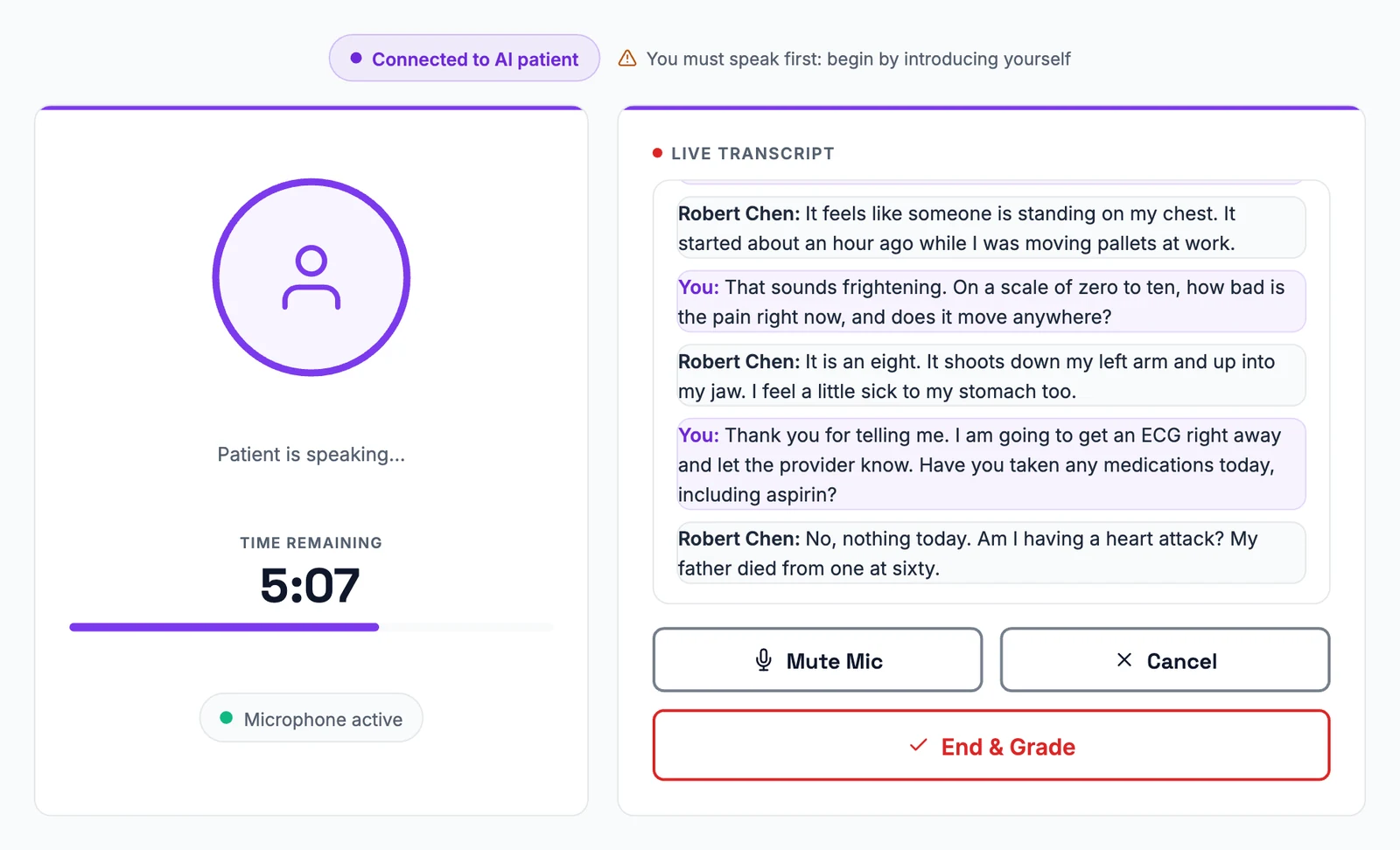
Live voice conversations with AI patients that respond to what the student actually says. No script, no decision tree. A built-in library, or your own custom scenarios in any of 18 clinical domains, 3 difficulty levels, every session graded against a nursing rubric in under 60 seconds. Formative practice, on the student's own phone, anywhere.
Improvement coaching
Not just scores. Specific, growth-oriented guidance with alternative responses and communication strategies for every interaction.
Domain 2 competency mapping
Every assessment scores AACN Essentials Domain 2 competencies (2.1, 2.2, 2.3, 2.5) with the NCSBN Clinical Judgment Model as supporting evidence. Next Generation NCLEX readiness, documented by competency number.
Program-wide analytics
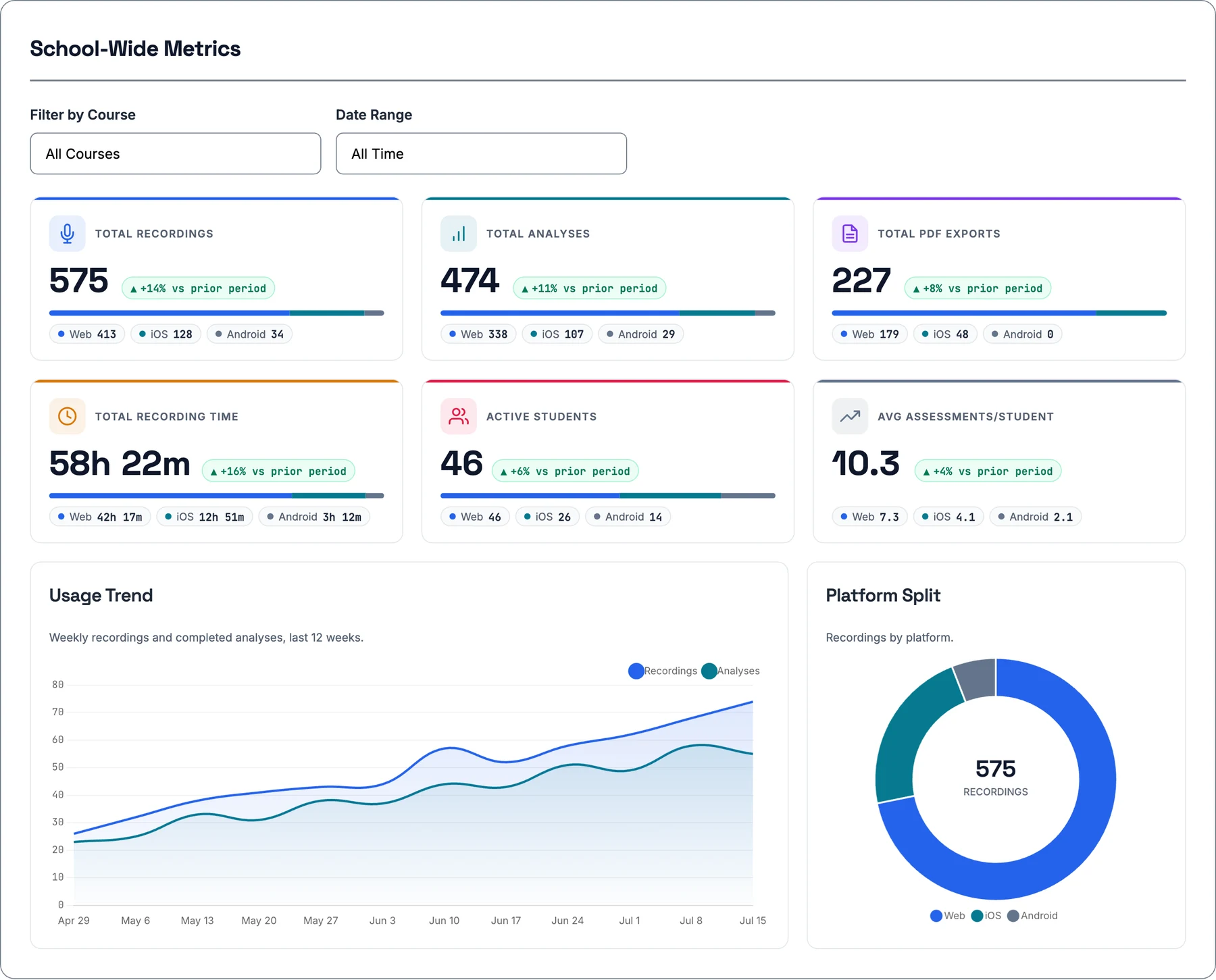
Track adoption, engagement, and outcomes across your entire program. Spot at-risk students early.
Export-ready reports
One-click professional PDFs for student portfolios and faculty review, scored against AACN Essentials Domain 2.
Group scenario assessment
Sim-lab teams recorded together on one patient scenario, graded as a single shared score instead of one student at a time.
Audio & video upload
Already have the recording? Faculty upload an MP3 or MP4 of an existing encounter instead of recording live. Graded the same way, no separate workflow.
Set the standard before students step into a clinical site
Faculty assign the scenarios. Students practice with AI voice patients on their own phone, anywhere, any time, no lab booking or headset required. Programs see readiness data before placement, not after an incident. Practice is formative by design; the Domain 2 evidence record comes from Assess. Simulation tools stop at the practice room. NurseKind AI also scores the real encounter. Practice also works as a class activity: project one student's session for the room and debrief live while it's fresh.
Live in minutes. Not months.
No complex implementation or lengthy onboarding. Import your roster, connect your LMS, and start assessing the same day.
Canvas / Brightspace (D2L) / LTI 1.3
- 05.1Bulk CSV upload: add hundreds of students instantly
- 05.2Custom rubric configuration: define your program's criteria once, applied to every assessment
- 05.3Roster & grade sync: LTI Advantage enrollment and grade passback
- 05.4Dedicated onboarding: faculty training and student orientation included

“I practiced therapeutic communication, taught it to nursing students, and watched programs fail to assess it. There was no standard and no tool. So I built one.”
11+ years in emergency psychiatric nursing and nursing education at Hofstra University. Her background as a psychiatric nurse practitioner is the reason this works. Therapeutic communication isn't a soft concept here. It's the product.
Ready for your IT and compliance review
Built for real clinical environments where patient information may be present: the answers your security team will ask for, up front.
HIPAA compliant
Deployable in active clinical placements. Business Associate Agreement (BAA) available for programs in clinical settings.
FERPA compliant
Meets federal requirements for educational records. Students can download their records, see who accessed them and request corrections in the app, and records are deleted after one year. Student data stays under your institution's control.
Encrypted end to end
All recordings and transcripts are encrypted in transit and at rest, with role-based access controls and audit logging.
Your data, your rules
Institutions own their data. Clear retention policies, MFA for faculty and admins, and documentation for security review.
Start with a pilot. Scale with your program.
No hidden fees, no per-feature upsells. AI Patient Simulation is included in every institutional plan.
Pilot Program
Test it with one cohort before full adoption
- Up to 100 assessments
- Unlimited faculty
- Full feature access, incl. AI Patient Simulation
- Web & mobile apps
- Implementation support & training materials
Institutional
The communication standard, program-wide
- Unlimited assessments & faculty
- AI Patient Simulation included
- LMS integration: Canvas roster import, Brightspace via LTI 1.3
- Student & school usage reports
- Dedicated training & priority support
Bedside by NurseKind AI
Private practice for individual students
- 150+ clinical scenarios
- Voice-based AI patient practice
- Real feedback in under 60 seconds
- Session packs that never expire
- Private practice, no grades
- Available on iOS and Android
Questions about procurement, quotes, or multi-campus pricing? Talk to us. We work with institutional purchasing processes every week.
What deans and directors ask us
Student & Faculty Access
Sign in to take an assessment, track your progress, or view your dashboard.
Watch a real encounter become a Domain 2 record
See a live assessment run on a real interaction, scored against AACN Essentials Domain 2 and NCSBN CJMM, and bring your own rubric if you'd like.
30 minutes · no pressure · see your own rubric scored live